
MY APPROACH
The Applied Adaptability Method
A developmental approach for people who are ready to examine what has shaped them, reconnect with who they are now beyond the social and professional personas they have learned to inhabit, and create a more consciously chosen direction.
Most people who find their way here have already done serious work on themselves.
They are not looking for motivation, reassurance or another set of generic answers.
Instead, they are ready to look more closely at the beliefs, roles and inherited definitions of success that may still be shaping their choices, and to decide what belongs in the next chapter.
That is the work of applied adaptability.
THE PURSUIT OF ADAPTABILITY
Adaptability is much more than coping with change
I named my company Adaptologie.
It is a portmanteau word meaning the ongoing study and pursuit of adaptability.
Adaptability is often reduced to resilience, flexibility or the ability to keep going. Those capacities matter, but they are only part of it.
Sometimes adaptability means persevering.
At other times, it means recognising that continuing along the same path is no longer serving you.
It can mean questioning an identity that once served you, noticing when an old definition of success has become too narrow, or accepting that the person who built your current life may not be the person who should design what comes next.
Applied adaptability is the ability to respond to change with greater awareness and choice. It means understanding what has shaped you without remaining governed by it, reconnecting with who you are now beneath the social and professional personas you have learned to inhabit, and participating consciously in the creation of your future.
It is not simply the capacity to adjust to the world as it changes.
It is the capacity to change your relationship with the world, and your place within it.

Behind all my work is a simple belief
Aspiring era-shifters deserve a future worth choosing.
By era-shifter, I mean someone who senses that a significant chapter of life or work has run its course and is willing to take an active part in shaping what comes next.
You may be standing at an obvious transition.
Or you may simply know that the life which still looks perfectly respectable from the outside no longer feels entirely like yours.
Choosing what comes next, rather than simply inheriting it, takes courage.
THE PHILOSOPHY UNDERPINNING THE WORK
Growth, not correction
My work is strengths-based. I begin with the assumption that there is already intelligence, capability and hard-won experience in the life you have built, rather than with the assumption that you are broken, deficient or in need of fixing.
The life you have built reflects intelligence, adaptation, responsibility and effort.
The roles you have played and the ways you have learned to operate may have served you extremely well.
The question is whether they still do.
Some beliefs, habits and identities remain useful.
Others may have become too narrow for who you are now or for the direction you want to take next.
So our work together examines key values, beliefs and other relevant structures, examining them without judgment. You then have options to retain what still belongs and create room for what wants to emerge next.
This is growth through greater awareness and choice, not self-improvement in pursuit of an impossible version of perfection.
LOOKING BENEATH THE QUESTION
What looks like a decision problem may be a design problem
People often arrive in my coaching practice with an apparently straightforward question:
Should I leave?
Should I stay?
What should I do next?
Why can’t I make this decision?
But the visible question is rarely the whole question.
Underneath it may sit an inherited definition of success, a fear of disappointing other people, an identity built around being capable and useful, or a belief that certain choices are no longer available to you.
When those foundations remain unexamined, it is easy to make a new decision using the same assumptions that shaped the old one.
The result may look different on the surface while reproducing the same underlying dynamics.
This is why I often widen the frame before we rush towards an answer.
We look at the life around the decision, the roles you have learned to play and the beliefs that have quietly become rules.
Only then can you begin to see whether you are solving the right problem.
What this looks like in practice
We make the implicit explicit
Much of what influences us operates discreetly in the background, often without us noticing:
the values we absorbed from our families
the behaviour that was rewarded at work
the definitions of success we inherited
the identities we became attached to
the fears that learned to present themselves as logic
Over time, these ideas can become so familiar that we stop seeing them as ideas.
They begin to look like facts.
I help you bring them into view.
This often involves listening for what sits beneath your words, noticing contradictions and asking questions that may initially seem unrelated to the issue you brought into the room.
Like a mirror, I may reflect a pattern you have not yet noticed.
I may question a conclusion that sounds entirely reasonable.
I may ask what you would want if you did not have to justify it.
I may also tell you when I think fear is wearing a particularly convincing disguise.
I will check my interpretation with you rather than assume I am right. You remain free to disagree, of course.
In fact, I would much rather you disagree than nod politely because I am the coach. That is how we build a relationship founded on mutual trust and respect.
We widen the lens
Capable people are often excellent at solving problems inside an existing frame.
The difficulty arises when the frame itself needs to be questioned.
This is particularly true during a major transition.
When a life or career has been built over several decades, the obvious choices can appear surprisingly limited:
stay or leave
continue or retire
be grateful or admit that something is missing
protect what you have built or risk losing it
These choices often look binary because we are standing too close to them.
Part of the work is to step back and look again:
What else might be true?
What are you assuming?
Have you tested those assumptions?
Whose definition of success are you using?
What possibility have you dismissed before examining it?
What might become possible if you stopped treating the current situation as permanent?
A wider perspective does not automatically produce a dramatic answer.
Often, it produces a more creative one.
Choices are rarely binary.
In my experience, there is usually an option C.
THE APPLIED ADAPTABILITY METHOD
Three forms of work, one evolving process
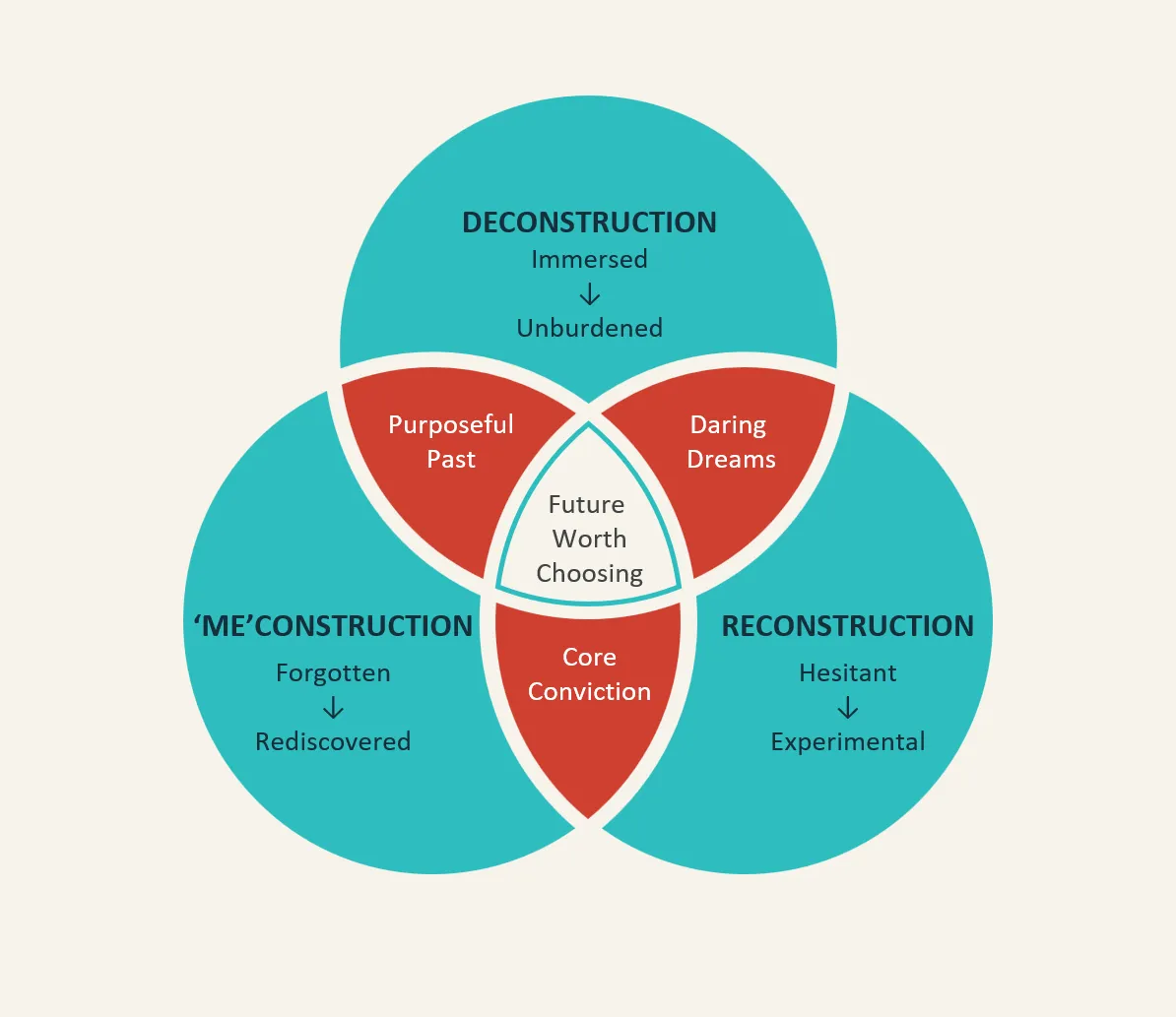
The Applied Adaptability Method gives structure to work that is deeply personal and rarely linear.
It involves three interconnected forms of work:
Deconstruction
Examining what has shaped you.‘ME’construction
Reconnecting with who you are now, beyond the social and professional personas you have learned to inhabit.Reconstruction
Creating a more consciously chosen direction.
These are not three neat stages completed in order.
New action may expose an old assumption.
Greater self-knowledge may change what you want to build. Looking back may alter how you understand the present.
The work moves between all three as required.
Deconstruction
Deconstruction is the work of examining what is shaping your choices now.
We look at the beliefs you inherited, the roles you learned to play, the definitions of success you adopted and the behaviours that helped you belong, achieve or stay safe.
For clarity, the purpose of this exercise is not to analyse your past in exhaustive detail or search for someone to blame. We are interested in the past only where it helps us understand the assumptions, patterns and loyalties operating in the present.
Some of these influences remain deeply useful. Others may have outlived their purpose or become too narrow for who you are now.
The aim is to distinguish what you continue to choose from what you may simply have continued carrying.
Questions we may explore include:
How do I define success?
What role have I been rewarded for playing?
Which parts of my identity feel chosen, and which feel inherited?
Which assumptions are shaping the choices available to me now?
What am I ready to question, retain or release?
Deconstruction is not about dismantling your life.
It is about creating enough perspective to make the next choice more consciously.
'Me'construction
‘ME’-construction is the work of reconnecting with who you are now, beneath the social and professional personas you have learned to inhabit.
It is often the hardest part of the work, and the part most easily skipped.
Once people understand what is no longer working, they naturally want to move towards a solution.
They begin looking for the next role, the next project, the next place to live or the next version of their life.
But without a stronger relationship with who they are now, they may design the future using the same assumptions that shaped the past.
The result can be a reinvention that looks different on the surface but feels strangely familiar underneath.
Over time, capable people can become highly identified with the roles they perform well: leader, parent, partner, provider, expert, problem-solver or dependable one.
These roles are real and may remain deeply important. But they are not the whole of you.
‘ME’-construction creates room to separate identity from function and ask questions that may have received very little attention while you were busy responding to work, family and other responsibilities:
Who am I when I am not performing a role?
What matters to me now?
What gives me energy, curiosity or a sense of aliveness?
What do I want before I explain why it is sensible, useful or achievable?
Which parts of me have been edited out, neglected or left unexplored?
What am I no longer willing to trade away?
What would feel more honest and recognisably mine?
The work involved in this phase is about ensuring that you are also present in the design of your own life. For clarity, this is not about becoming self-centred, rejecting responsibility or disregarding the people who matter to you.
The work develops greater self-knowledge, self-permission and self-trust. It helps you hear your own voice more clearly, distinguish genuine desire from reaction or escape, and establish the foundations from which meaningful choices can be made.
Without those foundations, reconstruction risks becoming a hurried solution to discomfort.
With them, it becomes the expression of a person who knows themselves well enough to choose more deliberately.
Reconstruction
Reconstruction is the work of turning greater self-knowledge into a direction you are prepared to live.
By this point, the aim is to begin translating what you now understand into choices, experiments and practical movement.
That may involve changing something significant. It may also involve making smaller changes that alter the way you work, relate, decide or use your time.
The emphasis is on testing rather than declaring.
You begin to explore questions such as:
What might this look like in practice?
What is one meaningful experiment I could run?
What would I do differently if I trusted this more?
Which conversations now need to happen?
What am I prepared to stop, start or renegotiate?
What would make this direction feel real rather than merely attractive?
Reconstruction is not about abandoning everything you have built.
It is about deciding what to carry forward, what to reshape and what to leave behind.
The work remains iterative. A new action may expose an old assumption. An experiment may reveal that something you imagined wanting does not fit after all. That is not failure. It is useful information.
The goal is not certainty before movement.
It is to act with enough intention to learn what the next version of your life is asking of you.
Reconstruction turns insight into lived evidence.
It is where a more consciously chosen direction begins to take form.
THE DEVELOPMENTAL MOVEMENT BEHIND THE METHOD
From self censorship to self authorship
The Applied Adaptability Method is designed to support a movement from self-censorship towards self-authorship.
Self-censorship is not always obvious.
It can look like being sensible, adaptable, professional or considerate. It may have helped you succeed, belong and manage complexity.
But over time, it can become a habit of editing yourself before you have fully heard what you think, feel or want.
The movement is gradual:
Self-censorship
I organise myself around what is expected, acceptable or safe.Self-permission
I allow myself to question the existing script and consider what I may want instead.Self-trust
I learn to take my own perceptions, values and desires seriously.Self-authorship
I make choices from commitments I have consciously examined and claimed as my own.
Self-authorship does not mean disregarding other people, rejecting responsibility or acting without consequence.
It means relating to expectations, obligations and relationships consciously, rather than allowing them to determine your choices by default.
The aim is to honour yourself, as well as others.
It is to become more able to know who you are, say what you mean and make decisions you can genuinely own & feel good about.
HOW I WORK WITHIN THE METHOD
Five principles shape the coaching conversation
The Applied Adaptability Method provides the structure and these principles shape how I work with you within this structure.
Intention before action
Before rushing towards the next move, we clarify what you are actually trying to achieve.
Capable people are often highly skilled at acting quickly. The risk is that speed can become a substitute for alignment.
We pause long enough to distinguish deliberate choice from reactive impulse.
The systems perspective
We do not look at one decision in isolation.
We examine the wider system around it: your history, identity, relationships, environment, organisational context and the assumptions influencing how you interpret what is happening.
This wider view often reveals possibilities that are invisible when the problem is framed too narrowly.
Growth over self-improvement
The work is not organised around an endless search for flaws.
We focus instead on expanding your capacity to see more clearly, choose more consciously and respond with greater range.
This does not mean shallow positivity. It means building from strength while remaining intellectually honest about what may need to change.
Dismantling the internal censor
We make the implicit explicit.
We pay attention to the narratives, institutional scripts and habits of self-editing that may be shaping what you allow yourself to think, say or want.
The aim is notice when self-censorship has become automatic, rather than eliminate discernment.
Reclaiming self-authorship
We do not judge the choices that brought you to where you are today.
We examine its foundations honestly, retain what still belongs and experiment with choices that feel more consciously yours.
Self-authorship is not rebellion for its own sake.
It is the ability to make decisions you can genuinely stand behind.
WHAT THE WORK ASKS OF YOU
Built for people who are ready to participate proactively
This approach may suit you if :
You have spent decades delivering at a high level and sense that the operating system that got you here is beginning to show its limits.
You want rigour, not motivation. Depth, not techniques. A thinking partner, not a cheerleader.
You are genuinely ready to examine the patterns running underneath your decisions, not just the decisions themselves.
You have tried coaching before, found it useful up to a point and are now looking for something that goes further.
You want to design the rest of your life deliberately, and you are prepared to do the work that requires.
You value confidentiality, intellectual honesty and a space where you can think without performing.
This approach is unlikely to suit you if :
You are looking for someone to hand you the answers, validate your existing plan, or tell you what you want to hear
You want a quick fix. This work takes time, and it asks something of you between sessions
You are not open to being genuinely challenged
You are in acute crisis, in which case a therapist or counsellor is a better starting point, and I will say so
You are entirely happy with the current direction of your life. This work is for people who sense there may be more and are ready to discover what that means for them.
ONE METHOD, TWO FORMS OF WORK
The same method can support different kinds of change
The Applied Adaptability Method sits beneath both my private coaching and The Fourth Side. The difference lies in how the work is structured.
THE FOURTH SIDE
The Fourth Side is a structured six-month application of the method.
It follows a defined developmental curriculum and combines private coaching with the perspective, challenge and companionship of a carefully curated small group.
1:1 COACHING
Private coaching is bespoke.
We begin with the situation, decision or pattern that matters most to you and follow the shape of the work as it develops.
There is no fixed curriculum. The focus remains entirely on you, your context and the questions that emerge.
HOW THE WORK BEGINS
Every coaching conversation starts with a relationship
In coaching, this is typically called a chemistry session. The term sounds more elaborate than the reality: two people meet to decide whether working together feels right.
You are considering whether you can speak openly with me, whether my style suits you and whether there is enough trust, warmth and substance in the conversation.
I am considering what is bringing you to coaching, whether your situation fits my experience and whether I believe I can be genuinely useful.
Neither of us is obliged to proceed.
The purpose is simply to make a thoughtful decision.
You do not need to know exactly what you want before we speak (although it helps work faster)
You may know precisely what you want to work on.
Or you may simply know that the current direction no longer feels right.
Either is enough for an initial conversation.